TWIL #029 - Owls Have Eye Tubes, Not Eyeballs
An owl's eyes are not spherical - they're elongated tubes fixed rigidly in the skull. The owl can't move them at all, which is exactly why it can rotate its head 270°.
- #animals
- #birds
- #biology
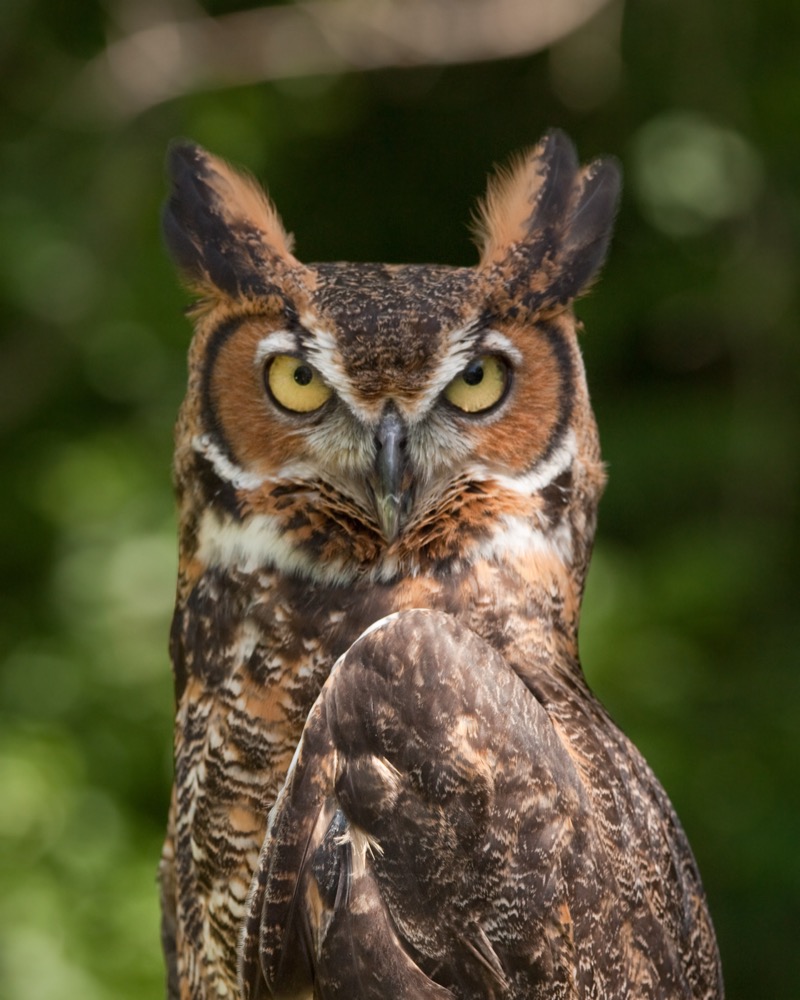
Most vertebrate eyes are roughly spherical and can rotate in their sockets. Owl eyes are neither.
An owl's eye is tubular - elongated toward the back of the skull, held in place by a ring of small bones called sclerotic ossicles. The tubes cannot rotate at all. An owl looking to its left cannot simply flick its gaze - it has to physically turn its entire head.
This is the actual reason owls can rotate their heads up to 270° in either direction (not 360°, despite the common misconception). The extreme neck mobility is a direct compensatory adaptation for fixed eyes.
The tubular shape is an evolutionary trade-off. Longer tubes pack in more rod photoreceptor cells and allow for a larger lens at the front - both of which dramatically increase light-gathering capacity. An owl's eyes are so large relative to its skull that they're essentially locked in place; there's no room for the muscle architecture that would allow rotation. A great grey owl's eyes, if they were proportioned to a human skull, would be the size of oranges.
Owls also have three eyelids: an upper and lower lid like most birds, plus a nictitating membrane - a semi-transparent inner eyelid that moves horizontally across the eye to clean and protect it without blocking vision.
The trade-off pays off in darkness: some owl species can detect prey in light conditions 100 times dimmer than the human visual threshold.