TWIL #054 - Brunelleschi Built the World's Largest Masonry Dome Without Scaffolding
In 1418, nobody knew how to build the Florence Cathedral's dome. Brunelleschi won the commission with a plan he refused to explain - and then built something still unmatched 600 years later.
- #history
- #architecture
- #engineering
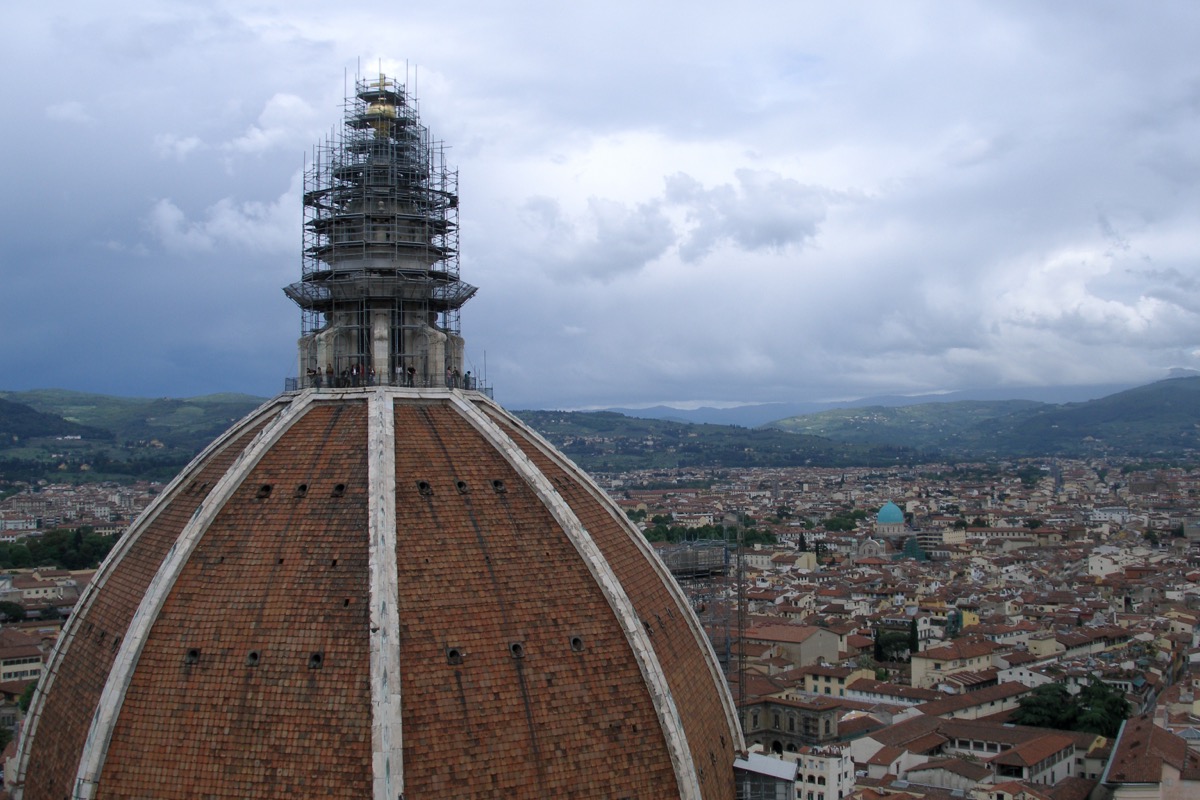
The Cathedral of Santa Maria del Fiore in Florence has a problem built into its foundations. When construction began in 1296, the architect designed an octagonal crossing - a vast eight-sided base - with the assumption that someone, eventually, would figure out how to put a dome on top of it.
By 1418, the nave was complete and the drum was standing. The hole at the top was 44.7 metres wide. Nobody had a workable plan.
The problem was not aesthetic. It was structural. A dome that wide, if built the traditional way - on a wooden temporary framework called centering - would have required so much timber that it was practically unobtainable in Tuscany. And if centering could somehow be built, it would have to support the dome's weight for years during construction before being removed. The mathematics of the outward thrust at such a scale had never been solved.
The competition: The Florence Cathedral Works announced a public competition in 1418. Filippo Brunelleschi, a goldsmith and self-taught architect, submitted a proposal - and famously refused to explain how he would do it. He reportedly told the judges: if they couldn't figure it out themselves, they should just trust him. He won the commission.
What he invented:
- Double shell: Two nested domes - an inner structural shell and an outer weatherproof shell - connected by eight large stone ribs and sixteen smaller ones. The inner shell carries the load; the outer protects it. This saved enormous weight compared to a solid dome.
- Herringbone brickwork: Bricks were laid in a herringbone pattern at regular intervals, creating self-locking rings. Each ring was structurally complete before the next was started, eliminating the need for centering entirely. The dome effectively built itself ring by ring.
- Horizontal tension rings: Stone chains and embedded wooden and iron rings at intervals acted as hoops around the dome, counteracting the outward thrust that causes masonry domes to crack.
- Custom machinery: Brunelleschi designed hoisting machines - including an ox-powered reversible hoist - capable of lifting stone and brick to over 90 metres. Workers spent their entire working day aloft; he also designed canteens and kitchens at height to avoid time lost climbing.
The dome was completed in 1436, 16 years after construction began. It weighs approximately 37,000 tonnes. It remained the largest masonry dome in the world until the 20th century and is still the largest ever built in brick.